The thing to understand about a "largest company" market is that it isn't really a question about Nvidia. It's a question about the distance between Nvidia and everyone else, and right now that distance is enormous.
Nvidia trades around $5.2 trillion, and the runners-up are clustered near $4.5 trillion or below. A trader pricing this at 71% is saying there's better than a one-in-four chance a roughly trillion-dollar lead evaporates in a bit over three months. That's a strong claim, and the evidence doesn't obviously support it.
Two useful anchors before the argument. As of mid-September, Nvidia's market cap sat somewhere in the $5.1 to $5.6 trillion range depending on which tracker you trust. That makes it comfortably the most valuable company on earth.
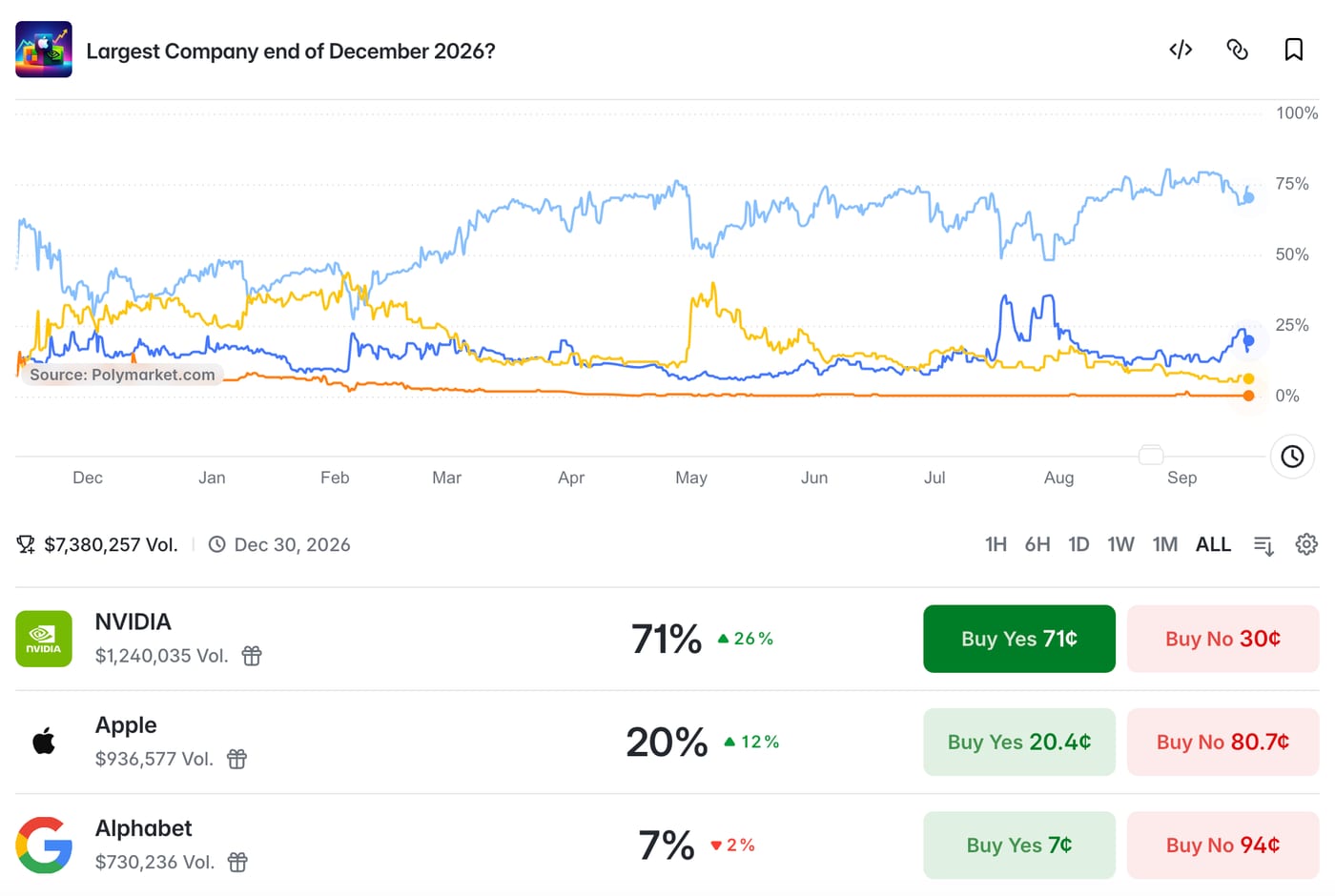
Apple and Alphabet have been swapping the number-two slot in the low-to-mid $4 trillion range, with Alphabet having briefly passed Apple back in January on the strength of its Gemini and TPU story. Here's how the market currently shapes up on Polymarket:
Why NVIDIA drifts up
Nvidia has been running roughly a trillion dollars ahead of the second-place company. Closing that gap in a single quarter would require the challenger to gain something like 20% while Nvidia stays flat, or Nvidia to shed a fifth of its value while the field holds. Both are possible.
The catalyst that would normally reshuffle a leaderboard, earnings, mostly falls the right way for Nvidia here. Its Blackwell chips have been sold out, which is the kind of demand signal that keeps a valuation aloft rather than deflating it.
Additionally, Wall Street analysts have expected the company to grow revenue by around 50% for the fiscal year ending in January 2027, and the recurring theme is that they've historically underestimated it. A company that keeps beating on the way up doesn't usually hand its crown to a slower-growing rival over ninety days.
There's also a structural point that flatters the 71%. Every one of the 27 other tickets in this market is priced at zero. Microsoft sits near $3.8 trillion and Amazon near $2.8 trillion, both so far back they'd need a historic move just to reach the conversation.
This is why the market has 71% confidence that Nvidia will be the largest company in the world by market cap on December 31, 2026?
Why could NVIDIA slip?
Nvidia stock has already wobbled, with its market cap slipping nearly 3% over one recent 30-day window. Also, a company valued largely on the durability of AI capex spending is exactly the company that gets hit hardest if the hyperscalers signal a pause.
You don't need a crash to threaten this market. You need one bad guide, one disappointing data-center capex number from a major customer, and a few points of multiple compression, timed unluckily around December 31.
Alphabet is the most feared challenger here, which is why Alphabet's 7% might be the mispriced number rather than Nvidia's 71%. Google recast itself from fading search incumbent to AI innovator, and its TPUs have become one of the more credible competitive threats to Nvidia's own franchise, drawing interest from Meta and Anthropic.
Alphabet was the top-performing Magnificent Seven stock in 2025 with a 65% gain, ahead of Nvidia's 39%, and its cloud revenue has been compounding at a rate that keeps surprising. A challenger that both grows faster off a smaller base and sells a product that eats into the leader's moat is the specific profile that closes trillion-dollar gaps. However, it's usually over years, not one quarter.
The quiet risk is that the resolution date is arbitrary and the race is close enough at the top of the pack that end-of-year noise decides it.
So, will NVIDIA be at the top on December 31?
The honest read is that 71% understates it. Nvidia has roughly a trillion-dollar lead, significant growth rate and a challenger field down to essentially two names; Apple and Alphabet.
Barring an AI-capex scare that hits Nvidia harder than the field, this should drift toward the low-to-mid 80s as December approaches and the remaining runway shortens.
The trade worth watching isn't Nvidia's number at all. It's whether Alphabet at 7% is too cheap for the one company here with a product that can actually take Nvidia's lunch.