
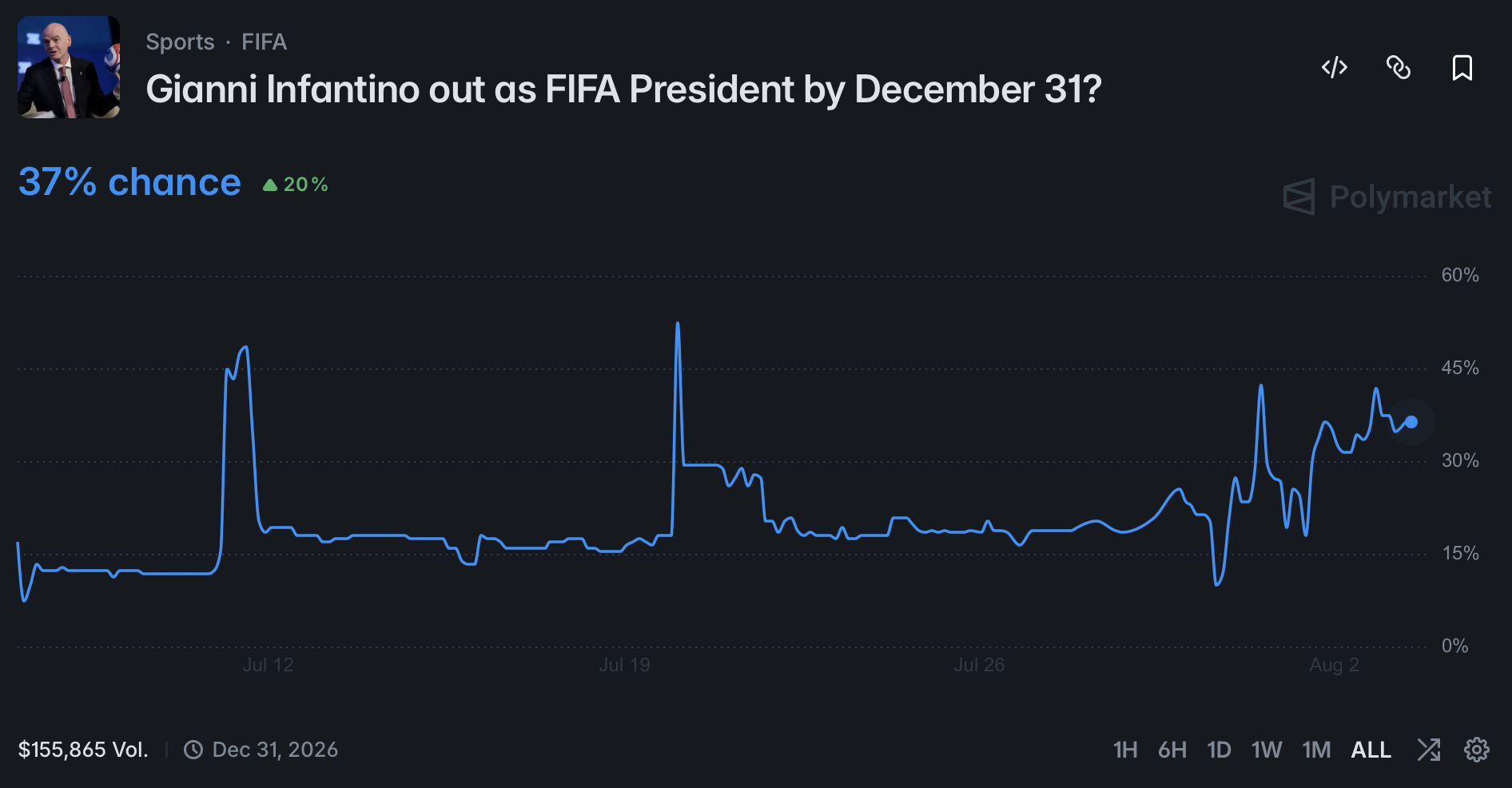
A week ago, traders had Gianni Infantino leaving the FIFA presidency by December 31 priced in the high teens. Today that same market sits at 37%, a jump of almost 20 points in seven days and the highest level that has actually stuck since the question opened in early July. Moves like that need a reason, and this one has a simple explanation. European soccer has turned on him.
The chart tells the story of a bad month. The probability spiked toward 50% twice during the World Cup, and both times it drifted back below 20% once the headlines moved on. What makes the past week different is that this is no longer a news cycle Infantino can wait out. There is now a process that could actually remove him.
Why Infantino's exit probability jumped 20 points in a week
The trigger was the most ambitious financial project of Infantino's decade in charge, and also the shortest-lived. In late July he unveiled FIFA Forward Enterprise, a plan to move future World Cups into a subsidiary and sell stakes to private investors. Reports put the capital target at roughly $8.2 billion, with up to $20 million offered to each of FIFA's 211 member associations to win their support.
Europe's answer arrived within days. On July 30, UEFA and all 55 of its member associations voted unanimously to reject the plan and boycott FIFA competitions, calling the proposal "governance by intimidation" and declaring that "the World Cup cannot be treated as an investment product." A September 19 approval deadline and warnings that holdout federations could lose most of their FIFA funding only hardened the resistance.
By July 31 the plan was dead. Infantino scrapped the sell-off entirely, admitting it had created divisions that ran against FIFA's interests. The climbdown bought him nothing. UEFA came back a day later with a formal statement that it had lost confidence in his leadership, along with a blunt choice: resign, or face a vote of no confidence. Inside FIFA the damage was already showing. Senior adviser Carlos Cordeiro, the former U.S. Soccer president, had resigned over the affair, and FIFA's own chief operating officer accused the president of misleading staff about the project.
The World Cup summer that weakened Infantino first
The sell-off fight landed on a president already damaged by his own tournament. The 2026 World Cup final ended with Argentina beaten, a red card, and an on-field brawl that FIFA is still investigating. Days later, a leaked letter showed Infantino praising Argentina's "professionalism" after that same final. Critics had spent a month alleging favoritism toward the runners-up, and to them the letter read like confirmation. It kept the heat on Infantino personally right up until the investment plan blew everything open.
That sequence explains why the price moved around so much in July. Traders had plenty of anger to react to but no route from anger to an exit. UEFA's ultimatum gave them one.
The FIFA no-confidence vote math traders are pricing
Removing a FIFA president mid-term is hard, but it is not impossible, and the math suddenly matters. Forcing a no-confidence motion takes 43 of FIFA's 211 member associations, roughly 20%. UEFA can supply 55 on its own. From there, FIFA would have three months to put it to the full membership, and a simple majority of the votes cast would end his presidency.
Run the calendar forward and the December 31 deadline comes into focus. If a motion lands in August or September, the vote to remove him would happen somewhere between October and December, inside this market's window. There is a slower path as well. Infantino faces reelection in March 2027, and challengers such as Concacaf president Victor Montagliani are already being openly discussed. So the question this market asks is not whether Infantino is wounded. It is whether the end comes in the next five months or next spring.
How much money has traded on the Infantino market?
So far, $155,788 has changed hands on the question. That is enough to take the price seriously but small enough that liquidity matters, and a determined trader could move it several points alone. Keep that in mind when reading the chart. A 20-point move in a market this size carries less information than it would with millions behind it. For scale, the market on LeBron James' next team handled more than a quarter of a billion dollars and still got the answer wrong.
What has to happen before December 31
For the Yes side to win, one of three things has to happen before the calendar turns:
- Infantino resigns under pressure, which is the fastest path and the least likely one
- At least 43 federations force a no-confidence motion and a majority votes him out before year-end
- Infantino cuts a deal to step aside early, handing over ahead of the March election
Anything short of that, including months of open warfare with UEFA, resolves this market No.
Is Infantino out by December 31 worth a trade at 37%?
The pressure is unprecedented, but at 37% the price now asks a lot of it. Infantino survived a Swiss criminal investigation in 2020 and years of ethics complaints without giving an inch, and killing the plan has already drained some of the anger.
Even a fast-moving removal effort runs on a slow clock and could slip past December 31 into election season. The simplest play for UEFA may be backing a challenger in March, which hurts Infantino badly but still leaves him in the job on January 1. The one thing that would change that read is 43 federation signatures actually materializing.
Frequently asked questions
How could Infantino be removed before December 31?
Either he resigns, or 43 of FIFA's 211 member associations force a no-confidence motion. FIFA then has three months to hold the vote, and a simple majority removes him.
When is the next FIFA presidential election?
March 2027. Infantino can stand again, though UEFA's loss of confidence makes a serious challenger far more likely than in past cycles.
What does the 37% probability mean?
It is the market's live estimate that Infantino leaves the FIFA presidency, by any route, on or before December 31, 2026. Put the other way, the market gives him a 63% probability of staying.
Prediction markets involve risk. This article reflects opinion and market analysis and is intended for informational and entertainment purposes only.